Monday, August 29, 2016

Josh White

It was Miami, Florida around circa 1961.   It was the "Beatnik" generation.    Coffee houses with espresso coffee were popular.   A friend told me of a new one called The Ravens Nest.  It was located in a small shopping center at the northwest corner of the intersection of Red Road and Bird Road for those of you who are familiar with Miami.  


One evening I decided to give it a try and see what it was like.   It was pretty neat.   After passing through the door there were two hallways:  one to the left which was dedicated to poetry readings (I didn't care for them) and to the right led to a room where guitar players would sing folk songs and the like (which I liked).   The hallways were dark and on the walls were designs painted with fluorescent paint illuminated with black lights (ultraviolet) like the pictures below.


You get the idea.    I became a regular at the Ravens Nest.  


I didn't care for the espresso coffee but I liked the music.   In general, the performers were pretty good and usually got a mild applause from the audience.   But then there was one night where the performer was spectacular.   Absolutely spectacular.   The audience went wild with applause after each song.   Not just applause but also loud cheering.    And I was enthusiastically applauding and cheering loudly along with the rest of audience.    I don't have the words to explain how good this performer was.    He played a 12 string guitar which I had never heard of or seen before.   The singers name was Josh White.


The audience was electrified and between songs he would talk.    I remember him explaining about the 12 string guitar and its qualities.   In a sense he was teaching the audience about a 12 string guitar.   When I left The Ravens Nest later he was sitting outside with several young white men and he was talking to them about segregation and discrimination.    I think that he was trying to educate the young men about the racial problems of the day.   They listened intently to him.   He had a mild manner of speaking that put the young men at ease.   At the time I didn't know who Josh White was.   His accomplishments and accolades accolades are much too numerous to list here.   Go to the Wikipedia site on Josh White.   You will be absolutely amazed.


In 1965 I left Miami and moved to Arizona to attend Arizona State University.   One day around 1967 while walking to class I saw a demonstration of anti-war protesters on campus.  The students were sitting on the grass.   That grassy area in the center of the picture below.  


They were sitting silently and listening intently to a guitar player/singer.   Yeah, you guessed it.   It was none other than Josh White himself.   I recognized him.    The young college students were entranced by his music and mild demeanor.   I stopped briefly to listen and I heard him telling the students that if they wanted to hold demonstrations be sure not to do anything for which they could get arrested.   He told them to be sure to finish college and graduate.   Then when they were in a position to have some influence to then make those influences manifest.    I thought that was good advice that he was giving to those students about not getting arrested.   Again he was educating others.   I wanted to go speak to him but I was on my way to class and couldn't wait.   I was really impressed by this man.    I honestly never realized how great he really was until I started researching his life for this blog.


I also collect commemorative postage stamps as a hobby.    I was glad to see a United States postage stamp issued in his honor in 1998.


So this is my story of my two encounters with the legendary singer Josh White.   I wish now that I had talked with him on both of those occasions.   Please feel free to add anything that you know of Josh White or encounters in the comments section below.

Tuesday, August 2, 2016

Catskill Fruit and Vegetable Garden

Circa 1946 my father went into the grocery business.   He opened a produce market and called it the Catskill Fruit and Vegetable Gardens.   It was located on Main Street in Catskill, New York.   Catskill is located about 100 miles due north of New York city on the west side of the Hudson River.    This is a very picturesque area.    My dad's store was easy to find, it was located right next door to Ted's Diner.
Both my father (Clyde Dallas) and my mother (Marietta Dallas) worked in the store.    They were a loving and devoted couple all their life.   They were always together.
As you can see in the picture below, it was a small store.   Just look at that old pick-up truck.   Can anyone make a guess as to what model and year it was?
Here is a happy customer.   One of many that I am sure that my dad had.
My dad ended up closing the market and went to work for a large grocery chain as a store manager.    My dad loved the grocery business and was in it all his life.

Being nostalgic I started wondering if the building where his produce market had been was still standing and if the building still looked the same.    I started searching with Google maps.    In the Google "street view" mode it lets you "drive up and down streets" pictorially.   All that I knew was that the store was in Catskill.    I took a guess and tried Main Street.   And sure enough there it was.   Remember what the building of the Catskill Fruit and Vegetable Gardens looked like?   There are two pictures below.   The first one is black and white and shows how the building use to look.   The next one is a color picture and shows what the building looks like today.
Yep, it looks pretty much the same.   I am glad.   It seems that so many buildings get torn down for shopping malls or gas stations or parking lots.   But now it does have a nice bright yellow coat of paint.
Now the question is what is being sold in the store where my dad's Catskill Fruit and Vegetable Gardens use to be.    You will never guess.   Go ahead and make a guess.   Yep, you are absolutely right, a store with produce for sale (and lots of other things).   Amazing after all these years that produce would be sold from this location.
There is a sign on the 2nd floor that says Catskill Country Store which must be the name of the business.

By the way the Catskill Country Store has a terrific website.   If you want to visit the website, here is the link.   It looks like a really nice store.

http://www.catskillcountrystore.com/

I know your next question, what about Ted's Diner.    Good question.
I am sorry to say that Ted's Diner is gone.   In its place is a nice little park.   There looks to be a plaque on the cement base of the flagpole.   Hopefully, the plaque commemorates that Ted's Diner was once there.
Well, I am glad that you shared my trip down memory lane with me.   It is nice to remember the good times.   May all of you who read this blog have your own pleasant trips down your own memory lane.   Don't be shy about leaving a comment.    Have a blessed day.    Lew

Saturday, July 2, 2016

alien creatures

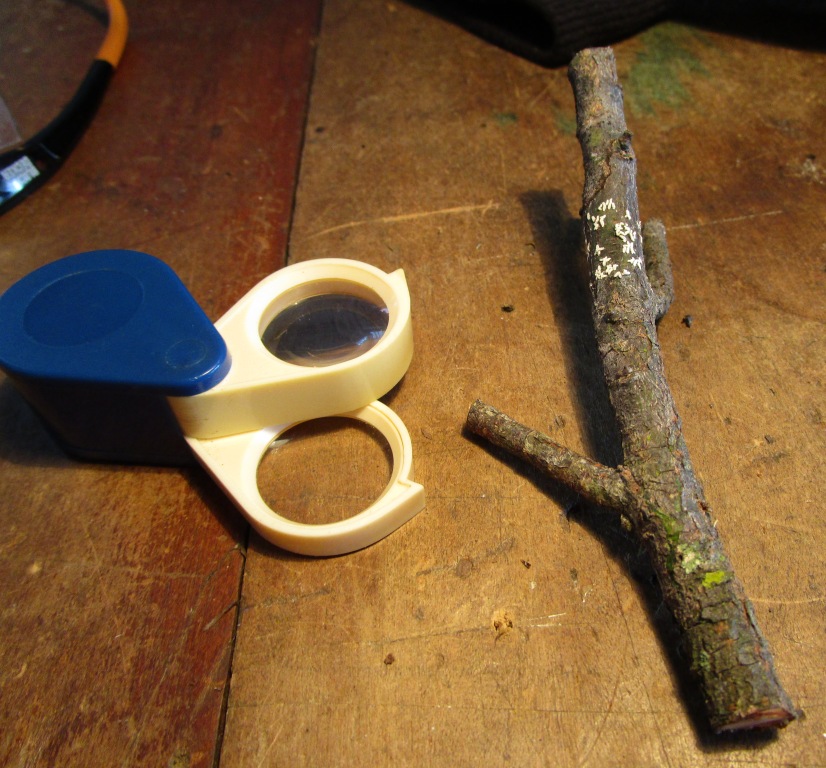
I was cutting some small tree limbs here in Central Florida.   I noticed some white specks on the tree limb.

My initial impression was that perhaps it was some sort of scale.   I went and got my loupe to put in front of my camera lens to get a close-up of these creatures.

And this was my result.   What kind of a creature was this?   I have never seen anything like it.   What is that line going down them.   And on some of them there is what appears to be tentacles around a primitive type round mouth.   Is my imagination running a little bit wild there?
Take a closer look.   See it at the bottom of the creature on the right?   What do you think?
I got out my trusty insect identification books.   And don't laugh, they have the common insects and I have managed to identify around 90% of the insects that I have found by using them.


 Have a good day and if you have any ideas at all as to what these mysterious creatures might be please let me know in the comment section.   I would appreciate it.     Lew

Saturday, June 18, 2016


We have two large and lovely gardenia bushes in the front yard.   They have gotten so large that their branches have overlapped and now the two bushes look like one giant gardenia bush.   They produce an abundance of flowers.
 
I did some minor pruning on them and noticed insects called "scale".   There were so many of them that I couldn't possible count them all.
 
I was curious as to what type of "scale" that they were.   I looked them up and they are terrapin scale, named that because they look like tiny terrapin turtles.
 
They just suck the sap out of the stems.   I am trying to find a way to eradicate them.   But I have one big stumbling block in my quest for a cure.   A well.   All of our water, including drinking, comes from a well which is located close to the gardenia bush.   I can't use pesticides or any other toxic chemicals because whatever I apply to the bush I will be drinking in the water about a month later.   I have to be able to safely drink whatever chemical I use.   Yeah, a real problem.   But I will see what happens.    For starters I cut all of the limbs that I could find that had the scale infestation.   But I can't do that too much.   I am afraid that pruning too much might damage the gardenia bushes.    Got any ideas?   Please drop a line in the comments.   Thanks.   Lew    


Friday, February 26, 2016

David and the SS Corregidor

It was a long time ago in a place far, far away.   It was the island of Luzon in the Philippines.


This is where David Goodman and the crews and boats of the U.S. Navy Motor Torpedo Boat Squadron 3 were on the night of Tuesday, December 16, 1941.   It was a new moon that night which meant that there was no moonlight thus making it a very dark night.   He and his crew mates were asleep in nipa huts in Sisiman Cove on the southern end of the island of Luzon.

                      Sisiman Cove

                            Nipa Hut
The PT Boats were normally based at the Cavite Naval Base near Manila Bay.    But the base had been attacked and destroyed by Japanese airplanes on December 10, 1941, so they shifted their base of operations to Sisiman Cove.   David was the radio man for torpedo boat PT-34 which was part of a squadron of six PT-boats:   PT-31, PT-32, PT-33, PT-34, PT-35, and
PT-41.   PT-34 was a famous PT boat and was featured on a poster during the war.
And it even had its own story in a comic book.


The residents of Manila were in a panic after the attack on the Cavite Naval Base.   They were trying desperately to escape the coming Japanese invasion.   The luxury liner SS Corregidor was an inter-island ferry traveling between Manila, Iloilo, Cebu, and Surigao.   Instead of departing at 3:00 pm as it usually did on its Tuesday schedule, it waited until 10:00 pm to depart so as to avoid a daytime air attack from Japanese planes.


The ship was leaving Manila on that dark Tuesday night loaded with approximately 1000 to 1500 passengers fleeing the coming Japanese invasion.   They were seeking safety on the island of Cebu further to the south.   The ship departed at 10:00 pm and was heading across Manila Bay on its way to Cebu.   The entrance of the bay was heavily mined.    These mines could be switched "on" or "off" from the Seaward Defense Command on shore.   Ships leaving the bay were required to notify Seaward Defense Command so that the mines could be switched "off".  Apparently Captain Apolinar Calvo of the SS Corregidor had not given any notification of their departure.   Around 1:00 am a gunboat, the USS Mindanao shined its lights


at the SS Corregidor as a warning that the SS Corregidor was off-course and heading for the armed minefield.   At around 1:00 am that night David and his crewmates were awakened by an enormous explosion.   They looked out over the black waters of Manila Bay and saw the dim outline of a ship sinking at the entrance to Manila Harbor.   It was the SS Corregidor.    It had struck one of the mines that were protecting the entrance to Manila Bay and harbor.   It was a 200 pound mine and the SS Corregidor sunk in four to five minutes.    David and his crewmates on PT-34 along with PT-32 and PT-35 left for the harbor entrance.   When they arrived there were numerous people in the water.   The water had a thick layer of oil on it from the SS Corregidor.   And the people in the water were covered with this oil.    The crewmen of the PT-boats put ladders over the sides of the PT-boats as well as casting ropes out into the water for people to grab onto and then they would haul the rope to the ship with the people holding onto the rope.   They would then lift the people onto the PT-boat which was difficult because the deck of the PT-boat was about three feet from the surface of the water.   It was a long distance to lift someone, especially when they were covered with oil and very slippery.    The other problem was that the deck of the PT-boat flared out slightly beyond the hull.   In the picture below the PT-boat is doing a daytime rescue with a pole and a rope loop.  You can see how the deck of the boat flares out from the hull.   On the PT-32, 34, and 35 boats they were trying to get the people in the water onto the boats as fast as they could before they drowned.
But as the people were pulled up, their life belts would catch on the lip of the deck making it even more difficult to get the survivors on board.    The cork blocks of the life belts were bulky and cumbersome as seen in the picture below.
The fabric of some of the life belts was so worn that the cork blocks could be seen through the fabric.   Each time a passenger was lifted aboard a PT boat their life belt would be thrown back into the water in the hopes that someone else in the water might be able to use it.    They worked all night and were exhausted when morning came and there were no more survivors to be rescued.    Of the 1000 to 1500 passengers, only 280 were saved.   The ship sank quickly, in about 5 minutes, and many were trapped below decks with insufficient time to reach the deck of the SS Corregidor.    Many owed their lives that night to David Goodman and his fellow crewmates on that dark night   To them, the sailors of the PT-boats were lifesavers, and were all heroes in their own right.   Some of the survivors were taken to Corregidor and some to the French ship SS Sinkiang.
                       SS Sinkiang
 
All of the survivors were eventually transferred back to Manila which is where they started from.   Seems like it was all for naught.    But there was a good ending for the survivors, they were eventually taken to Ilioli on the island of West Visayas which was their original destination.
Sometimes heroes are forgotten with the passage of time.   Let us not forget the heroes of the sinking of the SS Corregidor in Manila Bay at the outbreak of World War II in the South Pacific.    They all deserve to be remembered.
David Goodman then.
David Goodman in old age.   Still a hero.   Yeah, that is his wife making "bunny ears" with her fingers behind both their heads.   She had a terrific zest for life.


Sunday, September 20, 2015

The Tank

I recently got to visit The Museum of Military History in Kissimmee, Florida.    Where is Kissimmee?   It is very very close to Disneyworld.   I saw a tank on display in front of the museum and I was fascinated by it.   I got pictures of it from the front, from the back, from both sides, and even from some of the corners.   There were distant shots and close-ups.   As you can guess, I got a lot of pictures.    I went inside and asked the man behind the counter what model of tank it was.   He smiled and chuckled a little and said it was a model made from plywood.    I was stunned.   They had done such a good job that it had fooled me.    I guess that when you look up "gullible" in the dictionary you will find my picture next to the definition.    I had been absolutely completely fooled.  
What do you think?   Would you have been fooled like I was?
The museum  is great inside.   So much to see.   The exhibits and artifacts just seem to go on and on.    They have a tour guide who takes people around and gives a very nice talk.   Yeah, that is an Indian motorcycle.
I happened to see this German staff car and it reminded me of the Volkswagon "Thing" that was produced in the 60's and 70's.

If in your travels you ever happen to come to Central Florida, be sure to visit the Museum of Military History.   It is definitely a must see.   And it is easy to spot, just look for the big yellow tank out front.   LOL.    Lew


Tuesday, October 28, 2014

David and Helen Goodman

At the end of the movie Schindler's List they show a line of people passing Oskar Schindler's grave.   The people are the remaining present day survivors of Schindler's list.   As they file past his grave each person places a stone on his headstone/marker.   When I saw the movie Schindler's List for the first time I didn't understand why this placing of the stones on the grave was done.
There was a couple whom I knew by the name of David and Helen Goodman.   They were an elderly couple who I use to see in our local Walmart.   They would sit and talk with people, either on a Walmart bench or usually in the dining area of a small restaurant within the Walmart.   Everyone knew them, both employees and customers, and people would gather around them to join in their conversation.   It was as if they were a king and queen holding court.   They were absolutely delightful to talk to and that is why the people would gather around them, including me.   Here is Helen making "bunny ears" with her fingers for David and herself.   Notice the pin on David's cap?  Answer:  Navy officer.     And the printing on the left side of his jacket?   Answer:   Disabled American Veterans.
Yes, Helen was the lively one and so full of life.   She would talk a mile a minute.   David was more on the quiet side.   They were always together.   I never saw one without the other.
As time passed Helen seemed to become more frail.   But she always "kept court" with her legion of friends at the local Walmart.   The picture below was taken 3 weeks before she passed, and yet she is always happy and smiling.
Helen passed on first and then David followed six weeks later.   This seems to happen when the husband and wife are very close and have been together a long time.   I guess that one can't survive without the other.   A friend attended their funeral and visited their grave later and sent me a picture of their marker.   And there, on their marker were some small stones that had been left behind by visitors, just like in the movie Schindler's List.
I became very curious about this placing of the stones on a grave.   So I did a search on the internet.   I found several similar versions of its meaning: 
   a stone is placed as a sign of respect
   a stone is placed to participate in the marking of the grave
   a stone is placed to let the deceased know that you were there.
All are very good versions.   I visited their grave and left my own stone, for all three of the above reasons.     I hope that this blog will give an idea of what these two individuals were like.  These biographical sketches were taken from their eulogies.  Many thanks to whoever wrote their eulogies.   It is good to remember our friends and not let them just pass into obscurity.   I have always liked people and I consider myself lucky to have shared some moments with these two individuals, David and Helen.   The first part is about Helen since she passed first.
Helen (Bazar) Goodman
January 3, 1926 – October 22, 2012
Helen was born in Brooklyn, New York.  Her  parents, Henry and Fay Bazar, were immigrants from Poland.   Her father worked as a presser in the garment industry, and her mother, Fay, tended to her keeping a traditional Jewish home.   Helen came of age during the Great Depression.   Helen was able to graduate from high school during these difficult times.   Typical of a teenage female student of the time, Helen took a secretarial curriculum in high school and for a time after graduation she engaged in secretarial work.
   On a blind date set up by her sister Selma, Helen met David Goodman, a Navy radioman, who had been a prisoner of war, and a survivor of the Bataan Death March.   Acquaintance turned to friendship and then to romance and a wedding on February 20, 1946.   A marriage of mutual love, care, and support for well over 65 years. 
David Goodman
May 27, 1920 – December 3, 2012
David Goodman was born in Brooklyn, New York on May 27, 1920.    His parents, Benjamin and Sarah Goodman were immigrants from Lithuania.   His father was a laborer.   David graduated from Brooklyn Technical High School but could not afford to go to college.   Instead, David wanted to join the Navy and see the world.   But David was only 17 years old and needed his parents consent to join up.   When he didn't get his parents consent he went on a hunger strike and quit eating, finally forcing a reluctant agreement that he could become a sailor if he would eat his dinner.    David became a radioman 2nd class in the Navy and served on a torpedo boat (PT-34) in the South Pacific.   In World War II he was captured by the Japanese and was held in a prisoner of war camp for 2 1/2 years.   He endured a living hell working as a slave laborer in a stell  mill, incurring malnutrition, disease, and tortuous medical experiments.    He was released from the POW camp in 1945 and returned to Brooklyn.   He met Helen on a blind date and they were married on February 20, 1946.   David graduated from Officer Candidate School and rose to the rank of Commissioned Warrant Officer (CWO2).    This is a picture of David as a Commissioned Warrant Officer.   Yeah, I know it is blurry but it is the best that I have. 

David was stationed in the Philippines when war with Japan broke out in 1941.   David was a radioman on a PT boat (boat PT-34).  He was captured in 1943 and spent the duration of the war as a prisoner of war.   He endured a living hell working as a slave laborer in a steel mill, incurring malnutrition, disease, and tortuous medical experiments.   He was liberated in 1945 and returned to Brooklyn.   He married Helen on February 20, 1946.
          In the late 1950's he was given orders to Germany without family.   David did not want to leave his wife and children so he decided to retire from his last duty station which was the Naval Air Station in Sanford, Florida.    He finally settled in Ocoee where I had the pleasure of talking with him and Helen.    David received numerous medals for his military service.   His medals include:
The Silver Star indirectly awarded by General MacArthur.   There is a small silver star located in the center of the larger gold star.   I guess that is why they call it the Silver Star medal.
On the reverse side is the inscription "FOR GALLANTRY IN ACTION".   I guess that speaks for itself.
WWII Victory Medal
And the reverse side of the WWII Victory medal.
Asiatic-Pacific Campaign Medal
Military Service Medal

SECNAV Commendation (Letter or Medal?) under the hand of then Sec’y of the Navy Frank Knox;


Philippine Defense Medal

On the reverse side it says
Good Conduct Medal
  Navy Presidential Unit Citation ribbon
Prisoner of War Medal
Awarded for actions during World War II
Radioman Second Class David Goodman NSN 2234320, United States Navy was captured by the Japanese after the fall of Corregidor, Philippine Islands, on May 6, 1942, and was held as a Prisoner of War until liberated by U.S. Military forces after the end of hostilities in August, 1945.
David was held as a Prisoner of War in the Kawasaki 5D POW camp until that camp closed on June 4, 1945.   Then he arrived at the Niigata 5B POW camp where he stayed until the Rescue Team arrived on September 5, 1945.   Both of these camps were in the Tokyo area.
Did you keep count on the total number of medals and citations that he received?   I counted 8.   How many did you count?   Please let me know in the comments section if I miscounted.   What a chest full of medals he must have had on his uniform.   Quite a feat.
      After leaving the Navy, David and Helen eventually settled in Ocoee, Florida.   He operated a radio repair shop for a while but eventually went to work for the Florida Department of Transportation, repairing and maintaining communications equipment.
    After the war until he died, David suffered from what we now recognize as Post Traumatic Stress Disorder.   We us to say some military came back from the was "shell shocked".   When he might wake up at night in terror, Helen was always there to comfort and reassure him that everything was alright.   She devoted herself to him completely.   They were devoted to each other.   David died six weeks after Helen on December 3, 2012.
     Shopping at Walmart just doesn't seem to be the same without Helen and David there.   I hope that this biographical sketch has given some insight into this remarkable couple.   Thanks for reading this.
Lew